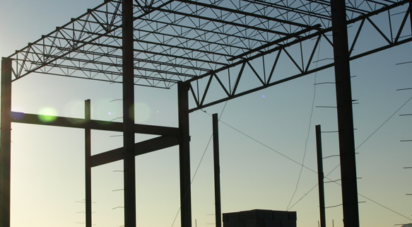
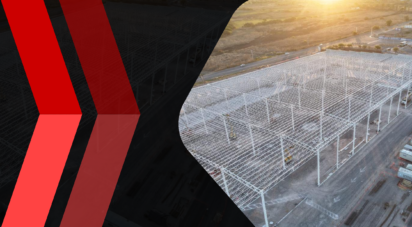
While they often work together to support a structure, Open Web Steel Joists (OWSJ) and Structural Steel Girders are manufactured through two very different engineering philosophies. Understanding these differences is critical for any project manager or engineer navigating the North American supply chain, particularly when balancing the high-volume capacity of Mexican fabrication plants with the strict site requirements of US construction.
1. The Engineering Logic: Repetition vs. Customization
At its core, the difference between a joist and a girder is one of standardization vs. specificity.
- Joists (The K, LH, and DLH Series): Joists are secondary structural members. They are typically engineered according to Steel Joist Institute (SJI) standard load tables. In a manufacturing environment, joists are products of high-efficiency production lines. The engineering focus is on optimizing weight—using the least amount of steel possible to carry a specific uniform load over a set span.
- Girders (The Primary Backbone): Girders are primary structural members that support the joists. Unlike joists, every girder is essentially a custom-engineered piece. They must handle “point loads” (the specific spots where joists rest) rather than uniform loads. This requires thicker flanges and heavier webs to manage the massive shear forces concentrated at the connection points.
2. The Fabrication Process: Jigs vs. Layouts
The shop floor reflects these engineering differences. If you walk through a major fabrication facility in a hub like Monterrey or Querétaro, you will see two distinct zones.
The Joist Line: Fabricating joists is an exercise in speed and repetition. Manufacturers use automated jigs—adjustable steel frames that hold the top chord, bottom chord, and the zigzagging “web” members in perfect alignment.
- The Web: In many modern plants, the web (the inner “V” shapes) is created from a single continuous steel rod or crimped angle, bent by machine and welded at the panel points.
- Welding: Because joists are lighter, they often utilize high-speed resistance welding or GMAW (Gas Metal Arc Welding) in a flat position to maximize throughput.
The Girder Bay: Girders are fabricated in a “heavy bay.” Because a girder might be a massive W-shape (wide flange) or a Built-up Plate Girder, the process is far more manual and scrutinized.
- Cambering: Most girders require “camber”—a slight upward curve engineered into the beam to counteract the weight of the concrete and steel that will eventually rest on it. This is achieved using massive hydraulic presses that “cold-bend” the steel.
- Fit-up: A “fitter” manually lays out the connection plates where the joists will sit. The precision here is vital; if a seat plate is off by half an inch, an entire row of joists may not fit during erection.
3. Quality Control: The “AISC/SJI” Barrier
For Mexican fabricators exporting to the US, quality control (QC) is the most important part of the manufacturing process. In 2026, the industry relies on IAS AC472 accreditation, which specifically audits the fabrication of metal building systems.
- Non-Destructive Testing (NDT): For joists, QC often involves visual inspection of every weld and periodic load testing. For girders, because they are “fracture-critical” in some designs, Ultrasonic Testing (UT) or Radiographic Testing may be used to ensure there are no internal flaws in the heavy welds connecting the flanges to the web.
- Traceability: Every piece of steel—from the smallest angle in a K-series joist to the heavy plate in a girder—must have a Mill Test Report (MTR). This “birth certificate” proves the steel’s chemical composition and yield strength, ensuring it meets ASTM standards.
4. Logistics and Sequencing
The final stage of fabrication is sequencing. Girders are heavy and take up significant space on a trailer, while joists can be “nested” (stacked inside one another) to maximize shipping volume.
In the US-Mexico context, fabricators often ship “Just-in-Time.” The girders for “Zone A” must arrive at the US job site first. If a fabricator accidentally ships the joists first, the site foreman has no way to hang them, leading to costly crane “down-time.” Advanced logistics software now syncs the fabrication schedule directly with the border-crossing schedule to ensure the “backbone” (girders) always arrives before the “ribs” (joists).
5. Conclusion
While joists represent the efficiency of the modern assembly line, girders represent the precision of heavy engineering. A successful project relies on the seamless transition between these two: the standardized speed of joist production meeting the custom-built strength of the girder.