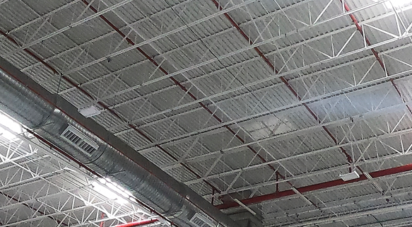
In structural engineering, there is no room for “good enough.” Every joist and girder manufactured by COMSA Steel must perform exactly as designed to ensure the safety of the occupants and the longevity of the structure. Our Quality Control (QC) program is a rigorous, multi-stage process that begins long before the first arc is struck and continues until the final product is loaded onto the transport trailer.
Quality begins with the raw ingredients. Every batch of steel that enters our facility is accompanied by a Mill Test Report (MTR). This document provides a chemical and physical “DNA” of the steel, confirming its yield strength, tensile strength, and carbon content.
At COMSA Steel, we don’t just file these reports; we cross-reference them with our project requirements. This ensures that a joist specified for a high-snow-load region in the north is built with the exact metallurgical properties required to handle those specific stresses.
The most critical point of failure in any steel joist is the weld. Because joists are “built-up” members, the transfer of forces depends entirely on the integrity of the joints where the web meets the chords.
A joist that is half an inch too short or has the wrong seat height can derail a construction schedule. Our QC team uses precision laser measuring tools to verify:
For critical primary members like Joist Girders or specialized heavy-duty spans, we employ Non-Destructive Testing methods. This allows us to “see inside” the steel and the welds without damaging the component:
The final step in our QC checklist is the application of the shop primer. We monitor the “Dry Film Thickness” (DFT) to ensure the steel is fully encapsulated. Proper coating thickness prevents “flash rusting” during the weeks or months the steel might spend exposed to the elements on a job site before the building is dried in.
Quality control isn’t just about catching mistakes; it’s about building a culture of precision. By the time a joist receives the COMSA Steel stamp of approval, it has passed through at least four independent checkpoints. This commitment to excellence reduces field fixes, prevents structural failures, and ensures that every project we touch is built on a foundation of certainty.