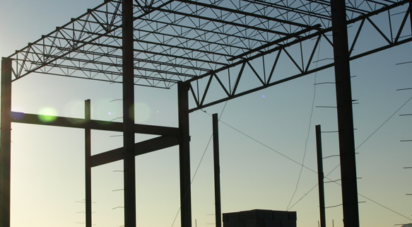
While standard open web steel joists are the “ribs” of a building’s roof or floor system, the Joist Girder serves as the “spine.” In the hierarchy of steel construction, understanding the specific role of the Joist Girder is essential for optimizing large-scale industrial and commercial projects. At COMSA Steel, we engineer these primary structural members to support the weight of the joists themselves, creating a cohesive and efficient framing system.
A Joist Girder is a primary structural member designed to support concentrated loads from steel joists. Unlike a standard joist, which typically supports a uniform distributed load (like a roof deck or floor slab), a Joist Girder is engineered with specific “panel points.” These points are the precise locations where the ends of the secondary joists will rest.
By utilizing a Joist Girder instead of a traditional hot-rolled wide-flange beam, engineers can often achieve a lighter total steel weight for the building while maintaining the necessary stiffness and load-bearing capacity.
The transition from heavy wide-flange beams to Joist Girders offers three distinct advantages for modern construction:
At COMSA Steel, we follow the SJI (Steel Joist Institute) nomenclature for Girders. A typical designation might look like 48G 8N 10K.
Manufacturing Joist Girders requires a higher level of precision in the fabrication shop. Because the concentrated loads are so high, the welding and fit-up of the chord members and web sections must be flawless. At COMSA Steel, our engineering team works closely with the fabrication floor to ensure that every girder is built to handle the specific rigors of your project’s blueprint.
By integrating Joist Girders into your structural design, you aren’t just building a roof—you are engineering an optimized environment.